What makes up the price of a solar (photovoltaic) system for a house, what decides its size and how to compare two quotes.
Updated:
Why there is no single price
"What does a photovoltaic system for a house cost" has no single answer, because two houses with the same roof can need different systems. One family is at home during the day and heats with air conditioners; another comes home in the evening and charges an electric car at night. That is why we do not publish a price list and prepare a quote once we have seen the data for the site.
This article describes what makes up the price of a solar system, what decides its size and what to look for when you compare quotes. "Solar" and "photovoltaic" mean the same thing here: a system that produces electricity from the sun.
What makes up the price
A photovoltaic system for a home is more than panels. A quote usually includes:
Photovoltaic modules (panels). Their number and power decide how much energy the system can produce.
Inverter. It converts the direct current from the panels into alternating current for the house wiring. A grid-tied inverter works with panels only; a hybrid one can also manage a battery.
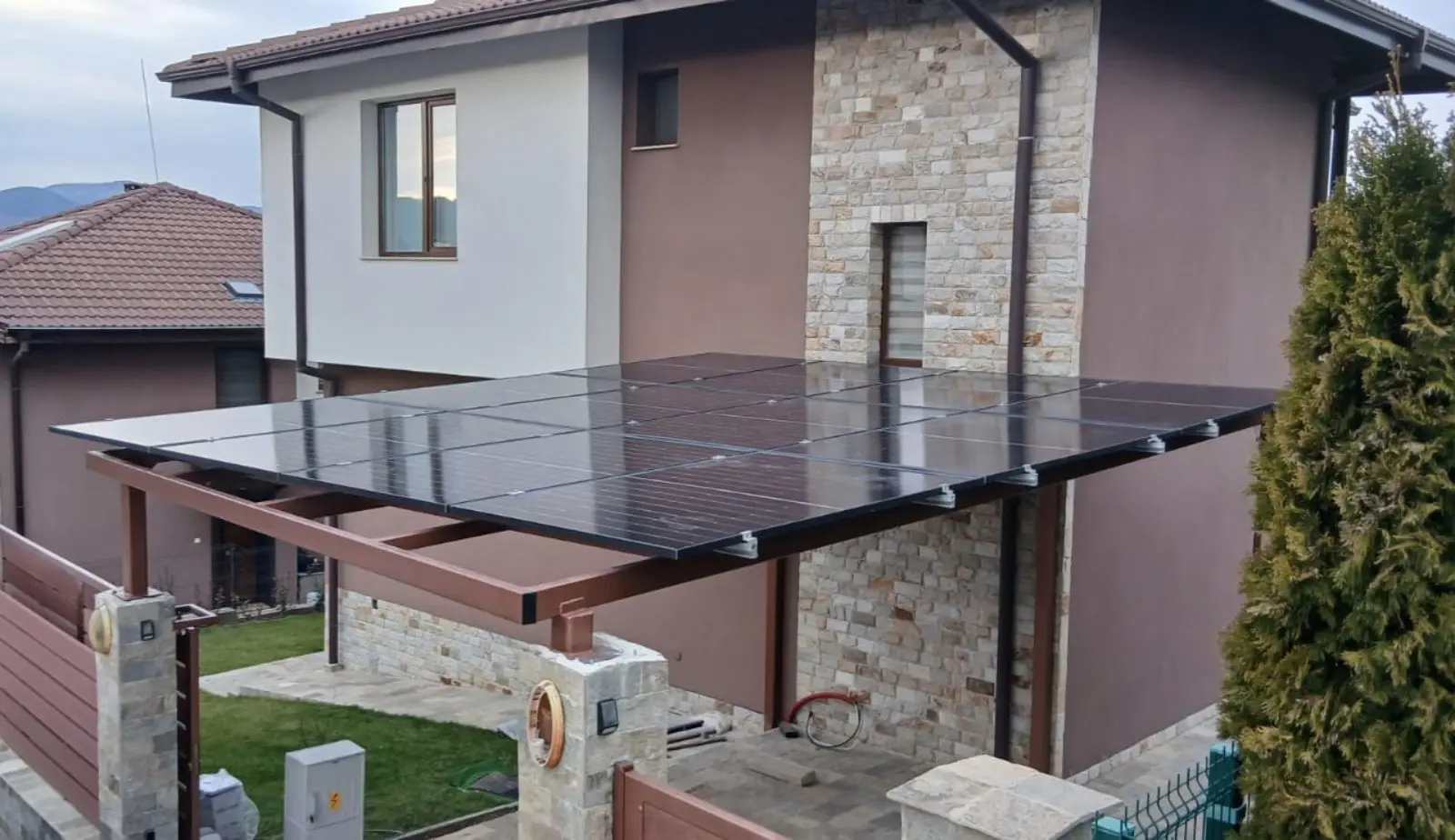
Mounting structure. It differs for a tiled roof, a metal roof and a flat roof; without a suitable roof the panels can go on the ground or on a carport.
Cables, switchboards and protection. The DC and AC sides, surge protection, breakers and earthing.
Metering and control. A meter or sensor at the connection point that lets the inverter follow the consumption and limit what goes to the grid where that is required.
Design and paperwork. The design documentation and the documents for the grid operator and the municipality.
Installation, testing and commissioning. Including setting up the monitoring and handing over the system.
Battery, if the system has one. That is a large item of its own, covered in with a battery or without.
What decides the size of the system
The power is not chosen by the free roof area alone. When sizing we look at:
Consumption. The electricity bills for the last twelve months show how much energy you use and in which seasons.
When you use the power. The system produces during the day. The more of your consumption falls in those hours, the larger the share of the production you will use yourself.
The contracted power. This is the power in your contract with the grid operator. It matters for the allowed power of the system and for the connection route.
The roof. Orientation, tilt, shading from chimneys, trees and neighbouring buildings, and the condition of the roof covering.
How much energy it produces
Production depends on the location, orientation, tilt and shading, so for a particular roof it is calculated in the design. As a reference: in its decision of 30 June 2026 on the prices of electricity from renewable sources, the Energy and Water Regulatory Commission (KEVR) assumes an average yearly production for Bulgaria of 1,339 kWh per installed kWp for an optimally oriented module.
That is an average for the country, not a promise for your roof. An east or west slope, a lower tilt or shade for part of the day change the result.
What adds to the price and where not to save
At the same power, two quotes can differ because of the conditions on site:
a battery and backup power for grid outages;
long cable routes between the roof, the inverter and the main switchboard;
an old switchboard or wiring that has to be reworked so the system can be connected safely;
difficult access to the roof, or a roof that needs repair before installation;
a single-phase or three-phase supply to the house.
We do not recommend saving on the protection, the cable cross-sections or the quality of the mounting structure. These parts are out of sight, but the safety and the life of the system depend on them.
How to compare two quotes
Check that the scope is the same: are the design, the connection paperwork, installation, testing and commissioning included?
Look for specific brands and models of the panels, the inverter and the battery, not just "10 kW of panels".
Compare the panel power in kWp, the inverter power in kW and the battery capacity in kWh separately. The article on the terms explains these units.
Ask what the manufacturer's warranties are for each device and who handles service after commissioning.
Ask whether there is monitoring and who watches the system.
Are there grants
Support programmes for households open and close. In 2023, for example, the Ministry of Energy accepted applications under a national scheme for households under the Recovery and Resilience Plan, which included photovoltaic systems of up to 10 kWp. Whether a call is open now, and on what terms, is checked on the website of the Ministry of Energy. Do not plan the purchase around a programme that has not been announced.
How to get an exact price
For a first assessment we need the address and purpose of the site, the electricity bills, the contracted power, photos of the roof and of the main switchboard, and what you expect from the system: lower bills, backup power or both. If some of the data are missing, we establish them at a site visit.
You can look at the ready-made PV + ESS packages on the photovoltaic systems page, collect equipment from the catalogue into an enquiry list, or simply send us an enquiry. We work in Kardzhali and the region and on projects in other parts of Bulgaria.